Everybody promises
transformation.
Everybody promises
outcomes.
Same models. Same cloud. Same talent. Same tools.
Technology is a commodity.
So the question changed.
What do you build?
What do you believe?
Business problems, analysed strategically and solved through brand solutions built to scale.
AI films and photography built to scale D2C brands without scaling the cost.

UI/UX and websites designed for how brands work in the AI era.
Creative talent tested on real-world briefs and matched to the teams that need them.
Giving a proven, technology-first company a bigger reason to be chosen.
Codewave is a technology-first company from Bengaluru. For thirteen years it has designed and built digital products, platforms and AI systems for names like Suzuki, Siemens, Titan and Microsoft, with the reviews to show for it.
The problem wasn't the work. It was how Codewave came across. Its story read like a list of capabilities, the same list every competitor had, so it kept winning steady projects but not the larger, $500K+ engagements it was built to deliver. It needed a reason to be chosen that no one else could claim.
We set out to find it: who actually signs, what Codewave believes, and how every touchpoint should say it. That became a new positioning and brand playbook, a sitemap built around the real buyer, a working homepage and a showreel.
Codewave's problem was never the work. It was that nothing about how Codewave presented itself was built to win bigger clients.
Its positioning sounded like every other agency's. Its message was written for CTOs comparing numbers, while the people signing were founder-side leaders. Its products told six separate stories, and its website was spread across five properties that couldn't hold one argument together.
“Agentic transformation done right” could have sat on any of nine competitor homepages. It described a capability, not a belief.
Everything was built for a CTO comparing numbers. The bigger cheques were signed by founders, CEOs and CXOs looking for reassurance, not ratings.
ImpactIndex, QuantumAgile, ZeroDX and the rest were sold as separate offerings, not as one reason to hire Codewave.
Five properties, 28 ungrouped services and differentiators that linked off-site. And the first proof a visitor met was popularity, not outcomes.
The brief said CTOs. One recent CTO client had come in through Codewave's Crunchbase score, so the instinct was to lean into numbers and technical relevance.
Then we went through who had actually signed. Most of Codewave's clients weren't deep in the technical detail at all. They were CEOs, founder's-office leads, CXOs and senior technology heads at large enterprises: people close to the founder, answering for the outcome.
A CTO's journey is short. They know what they want and can compare numbers anywhere. The people who signed the bigger cheques needed something else: an ambition to look forward to, and the reassurance that if they came to Codewave, the work would get done.
The brief named a CTO, and one recent CTO client had arrived through Codewave's Crunchbase score. So the instinct was to lead with numbers.
The signed client list said otherwise. The people who approved the larger engagements sat beside the founder, not inside the stack.
“Show me the numbers.
I'll compare them myself.”
“I know what this could become.
I need someone who can make it real.”
Architecture, stack, delivery capacity, certifications.
Position, growth and margin — what the next twelve months have to prove, and to whom.
Short and technical. Shortlists from a spreadsheet.
Longer, and shared with a board or founder. Their own credibility is on the line.
Clutch scores, Crunchbase heat, ISO badges.
An ambition worth backing, and reassurance that the work will actually get done.
Ratings and capability lists — what the old homepage said to everyone.
A belief they can buy into, then the proof that it holds in real, named work.
Different titles, the same exposure.
The title on the business card kept changing. The exposure behind it never did — whoever signs answers for the decision a year later.
Numbers get a company shortlisted. They don't get it signed. Every competitor had the same scores on the same platforms.
So the homepage had to stop opening with proof and start opening with a belief: something a leader could point at in twelve months and say that was the idea.
We read the homepages of the nine competitors a Codewave buyer would also be reading, word for word. Cheesecake Labs, hedgehog lab and GeekyAnts were all saying a version of the same line. Only one, frog by Capgemini, felt different: design-first, and built on aspiration rather than capability.
Everyone promised transformation and outcomes. Nobody stated a belief.
“Your reinvention and experience partner.”
frog · Capgemini“Turning complex systems into modern AI-ready solutions.”
Cheesecake Labs“A global UI/UX design agency curating experiences that scale businesses.”
Lollypop Design“The digital product studio for changemakers.”
hedgehog lab“Turning ambitious technology strategies into production-grade reality.”
GeekyAnts“Enterprise AI that performs in production, not just in pilots.”
Appinventiv“Data engineering, applied AI, modernisation, for enterprises and unicorns.”
Wednesday Solutions“Reinvention services for the total enterprise.”
Accenture“Global technology consultancy that integrates strategy, design and engineering.”
ThoughtworksEverybody promises
transformation.
Everybody promises
outcomes.
Same models. Same cloud. Same talent. Same tools.
Technology is a commodity.
So the question changed.
What do you build?
What do you believe?
Instead of asking what services Codewave offers, we asked what philosophy connects everything it does. Then we asked a harder question: if we removed every service, what belief would still be there?
The answer was already in the products. ImpactIndex, QuantumAgile, ZeroDX, Design Thinking, Outcome Billing and AI Engineering didn't read like six separate offerings. They read like six ways of saying one thing.
Codewave's six productsWhat it sells today, before the belief
ImpactIndex™Impact framework QuantumAgile™Delivery framework ZeroDXEngagement model Design ThinkingDiscovery practice Outcome BillingCommercial model AI EngineeringBuild capabilityThe belief that remainedEvery ambition deserves to be real.
Three complete positions, each built around a different belief and written for a different kind of leader. Same team, same capabilities, but a different Codewave in each: a different client, site, deck and showreel.
Leadership chose one in a single working session.
Three routes. One to pick.
Tap a route to read it
Every business leader who comes to a partner like Codewave already has the idea. What they're looking for is someone who will make that exact idea real, without losing it on the way. Build what they imagined, and show it working.
Technology isn't scarce. Ideas aren't scarce. Ambition isn't scarce. Execution is. That gave Codewave one belief to hold, and a line to carry it.
Every ambition deserves to be real.
The Codewave belief.
Help meaningful ambition become reality.
A world where ambitious ideas don't remain ideas.
Turn meaningful business ambition into real-world impact.
Make sure ambition survives execution.
The belief turned Codewave's product list into a single argument. Each framework now answers one question a leader has about their ambition. Hover or tap a framework.
One belief, plugged in everywhere
Every Codewave framework connects back to the same promise.
Midway, we hit a problem with Codewave's own team. If every ambition deserves to be real, doesn't that invite everyone? A line this open could fill the pipeline with exactly the wrong enquiries.
We kept the belief and added a filter. The homepage and showreel quietly speak to leaders who have the funding and capital to make an ambition real, and the enquiry form asks for position level before anything else.
The filter, in the product
Bring us the problem slowing your roadmap.
A belief only works if the whole company holds it. We wrote a 37-page strategy and playbook for leadership, employees, sales, design, partners and external agencies: why Codewave exists, what it believes, how it behaves and how it should sound.
Codewave can hand it to anyone who represents the brand, internally or outside, and get the same story back.
Codewave's existing trilogy of Relevance, Agentic and Outcomes stayed central. The belief gave it a destination, and the three proof systems became the evidence at each step.
Before making something real, make sure it's worth making real.
Design ThinkingTechnology is the force. Ambition is the direction.
QuantumAgile™Reality is judged by what happens after launch.
ImpactIndex™ · ZeroDXUnderstood, useful, working, adopted, valuable, scalable.
“We built it” isn't the bar. The playbook defines six tests an ambition has to pass before Codewave can call it real, and every case study and sales conversation is judged against them.
The right problem and opportunity are clear.
It solves a meaningful user or business need.
It performs in the real world, beyond a controlled demo.
People and organisations actually use it.
It creates measurable business or human value.
It holds up under growth, complexity and production demands.
Lead with the point. Back it with proof. The playbook retires category language and replaces it with lines that talk about ambition before technology.
“We leverage cutting-edge AI to drive digital transformation.”
“The pilot worked. Now let's make it work in the real world.”
“We empower organisations to unlock the future.”
“The ambition is clear. What's stopping it from becoming real?”
“We deliver end-to-end digital solutions.”
“Build the thing. Put it to work. Prove what it changes.”
Codewave had asked us to look at its sitemap and information architecture too. We audited the site as a senior decision-maker arriving cold.
The estate was spread across five properties, each with its own navigation. The frameworks that made Codewave different sent visitors to other domains just as they became interested. Products, services and fast-track offers sat side by side with no clear logic, so a buyer couldn't tell what to pick or where to start.
ImpactIndex and QuantumAgile, the answer to “why you”, linked out to other domains at the exact moment a buyer became persuadable.
A flat grid with no grouping. Design Thinking, Codewave's defining discipline, sat beside iOS and eCommerce as one more tile.
“Xpress Value”, a catalogue of fast, lower-priced offers, sat ahead of Work and Industries in the main menu.
Culture was the biggest menu. The company story sat three levels down, and the only routes were “Contact” or a download.
We card-sorted every service by what the buyer is trying to make real, not by how Codewave staffs it. Overlaps were merged, process language was cut, and the products moved out into their own family: The Model.
What was left grouped cleanly into six capabilities, each one something a leader can point at.
The new structure was built around the questions a founder-side buyer actually asks, in the order they ask them. Six items in the main navigation, one primary action, and the three frameworks brought home under The Model.
If a buyer wants to find something, there is one obvious way to get there. Pick a question to see the path.
Every homepage section answers a question a buyer has. The old page answered them in the wrong order: popularity second, belief seventh, and no ask at all. Watch the same page reorganise.
It now opens the page instead of arriving after the portfolio.
Moved down to back up the story, merged with testimonials and certifications.
No longer links away to other domains at the moment a buyer is interested.
The page now ends with one action: bring us the problem.
The award banner, VC logos and twelve rotating AI equations.
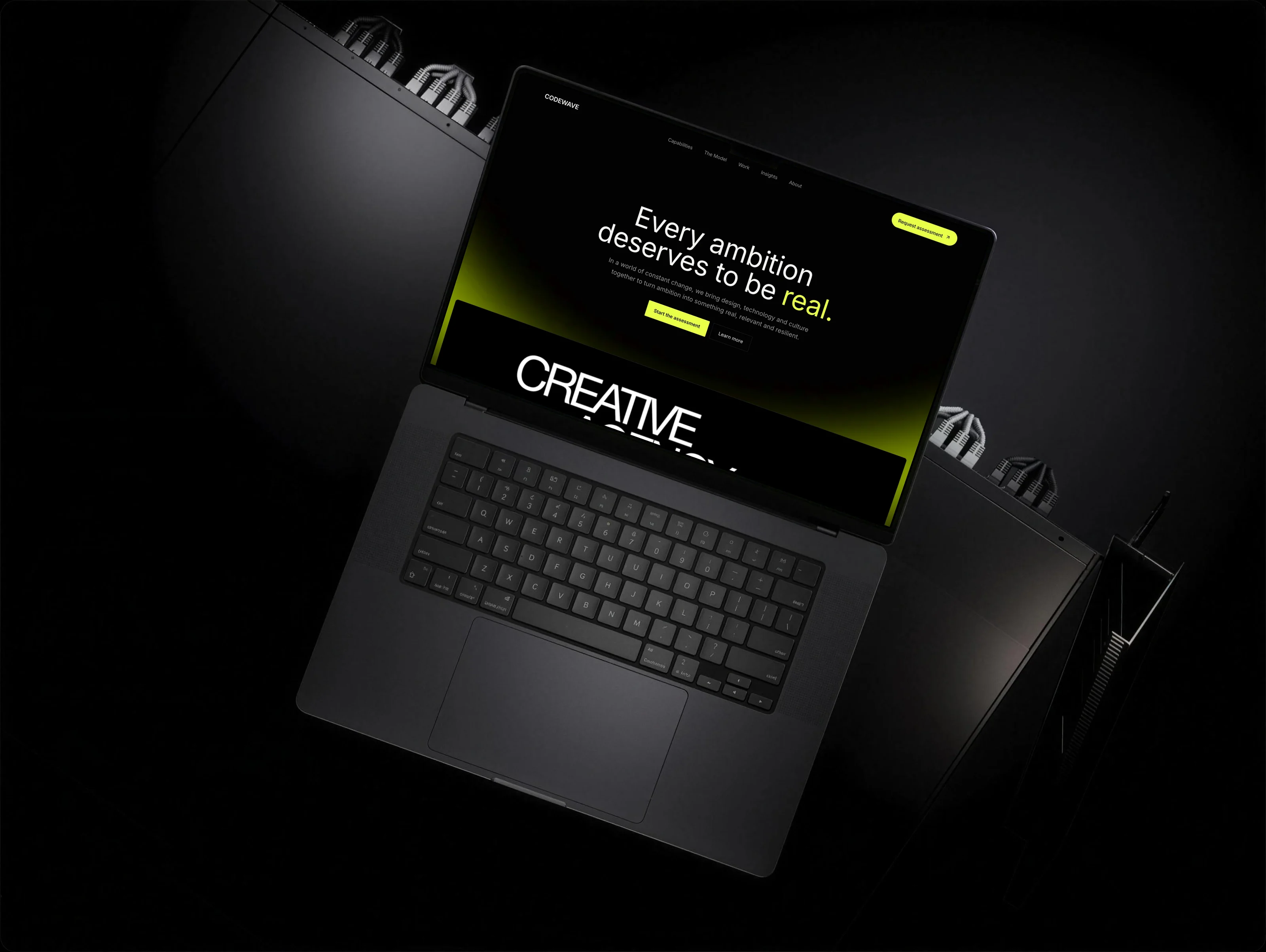
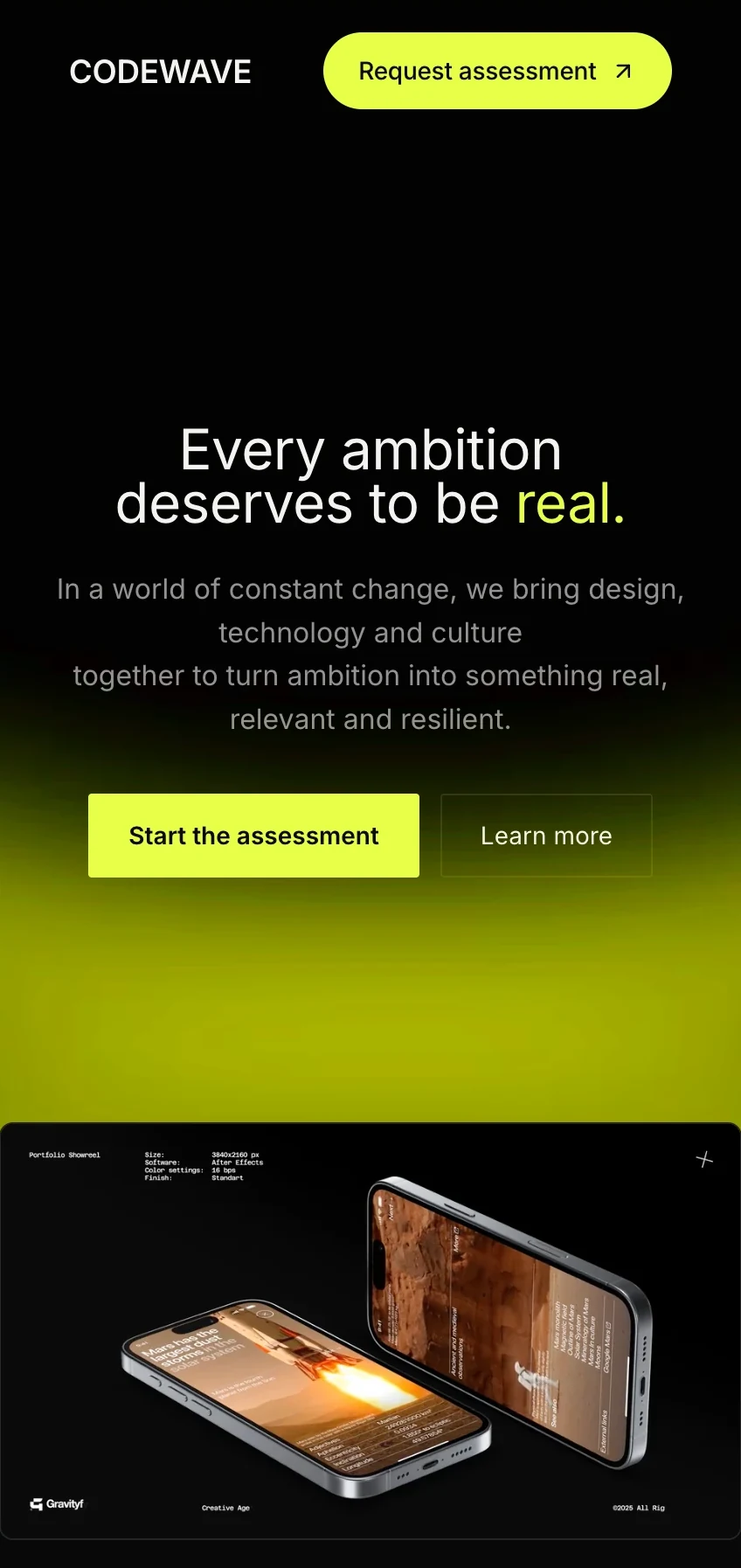
The brief asked for a wireframe. A wireframe can't show how the belief feels at scroll speed, so we built a working prototype instead, with real copy, real motion and the new structure end to end.
It reads in the order a founder decides: the promise, the stance, the system that earns it, the work, what Codewave makes real, and only then the scores, the questions and the ask. Scroll to move through it, or open it and try it yourself.
Each part of the page on a real screen, in the order a founder meets it: the promise, the stance, the model, the capabilities, the AI Radar and finally the ask.
The model: Codewave's three pillars, ImpactIndex™, ZeroDX and QuantumAgile™, made interactive. Scroll, and each one shows how it works02


We didn't present the route as a slide. On the review call, we opened the working homepage for Codewave's team, then the sales pitch deck built on the same belief. Both lead with the same line, so what a visitor reads on the site is what a prospect hears in the pitch.
The team was very happy with what they saw: their belief, working on a real page and ready for the next sales conversation.
We sat down with Codewave's leadership in person to walk through the positioning, the playbook, the sitemap and the working homepage.
This is what they said about it, in their own words.
The work left it with one belief, a playbook that carries it, a sitemap built around its real buyer, a working homepage and a showreel. The site is being built from this system.
Every piece answers to the same test the playbook sets for every Codewave story: did the ambition become real? The website, the sales conversation and the work itself are now built to pass it.
$500K+ engagements with founder-side leaders, not more of the same.
Strong reviews, a federated website and a category saying one sentence.
Every ambition deserves to be real, built into positioning, playbook, IA and homepage.