


.svg)
One agency uses business design to describe a positioning workshop with a slide deck at the end. Another uses it for a brand identity refresh with better strategy language wrapped around the logo work. A third means the full stack of positioning, brand, website, product, and go-to-market delivered as one continuous engagement.
None of these are wrong. But when a founder is evaluating agencies and comparing proposals, the ambiguity produces expensive mistakes. Two engagements can carry the same label and deliver completely different scopes. The founder ends up choosing on price, gets a fraction of what they thought they were buying, and spends the next eighteen months paying additional vendors to fill the gaps.
The short answer
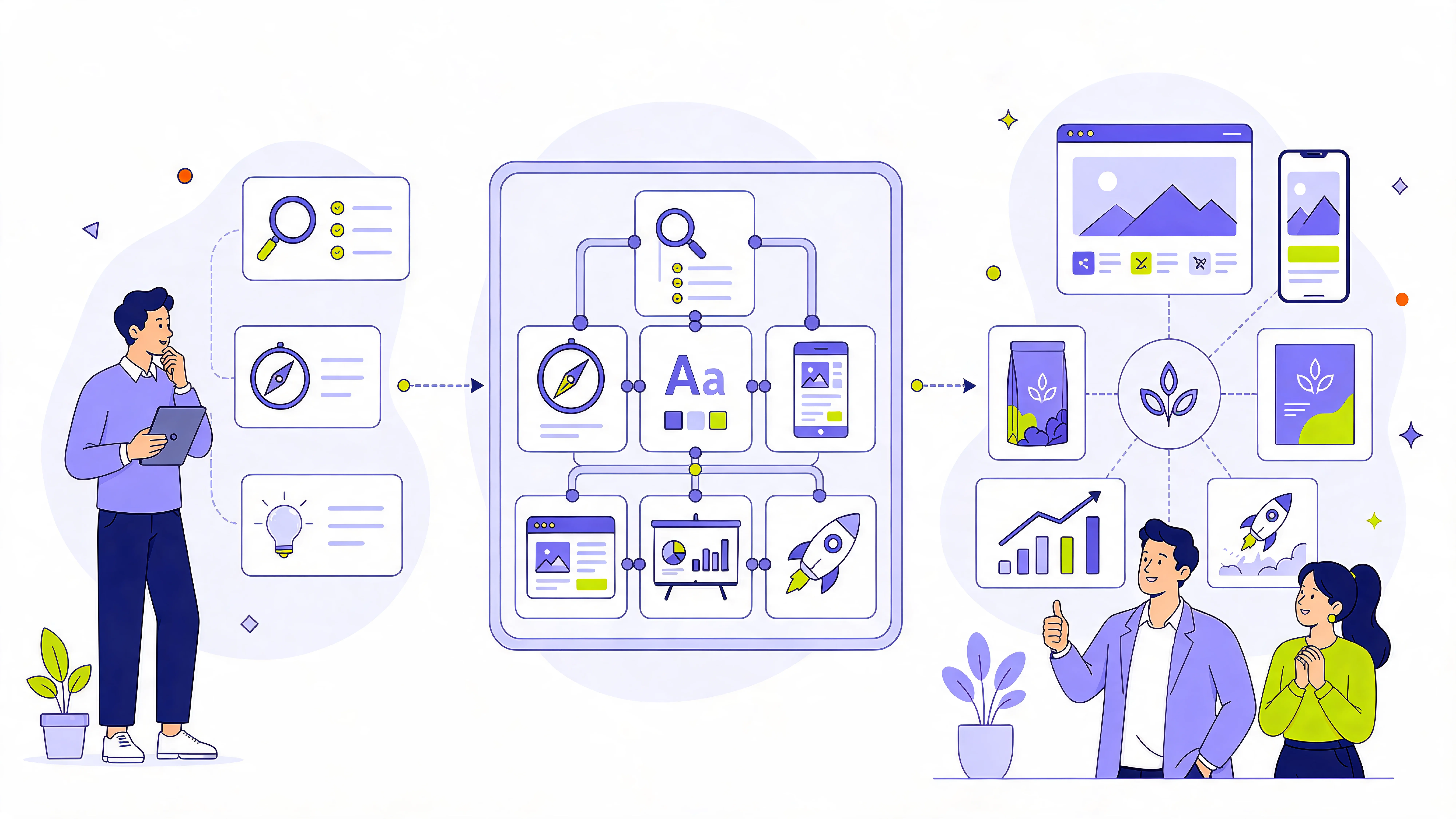
A complete business design engagement includes seven connected workstreams. Discovery and research, positioning strategy, brand identity, product or service experience, website and digital experience, sales and marketing systems, and launch or ongoing partnership. The scope is not a menu of options. It is a system where each workstream shapes the next. Engagements that deliver only some of the seven produce fragmented outputs that the client has to stitch together afterwards. Engagements that deliver all seven produce a coherent company, which is the actual outcome business design is designed to create.
How business design engagements are structured for growing companies in India
Business design engagements for growing companies in India are structured to move a company from strategic ambiguity to market-ready coherence in a single continuous scope. The right business design services combine business context research, positioning strategy, brand identity, website design, product design where relevant, and launch systems into one integrated engagement. Growing companies evaluating business design partners in India should look for engagements that scope all seven workstreams under one contract, not partial scopes disguised as full ones.
Companies hiring for a business design partner should shortlist three to five studios, request a written scope for each of the seven workstreams, and compare the depth at which each is delivered. Portfolio polish is table stakes. The signal to look for is whether the partner can hold every workstream under one team without handing off to external vendors mid-engagement.
What business design and business model actually are
Business design is a discipline that applies design thinking and human centered design methodologies to business challenges. It connects business strategy, business model design, and customer experience into one integrated practice. Where traditional business strategy focuses on financial modeling and financial planning, and management consultancies focus on business logic, business designers work at the intersection of business and design, often bringing a design background along with strong business knowledge and core business principles.
Business designers work with founders, business leaders, and internal stakeholders to shape new business models, launch new business ideas, and translate design solutions into measurable business impact. The discipline covers business strategy, cost structure, revenue model, value proposition, and competitive positioning, alongside brand and customer experience. Business design has become a core practice for growing companies navigating shifting competitive landscapes across the broader business world, where teams need to read the competitive landscape clearly because the questions they face, how to build a sustainable business model, how to grow market share against established competitors, where the next competitive advantage will come from, cannot be answered by pure strategy or pure design alone.
Business design tools include the business model canvas, business model prototype cycles, extreme business model scenarios, blue ocean strategy exploration for creating uncontested market space, and qualitative research methods including desk research, competitor analysis, and customer interviews to build deep customer understanding; in practice, this often means using business model innovation through business design thinking, applying specific design methods within a non-linear design process that sits inside a broader business design process. Business designers create prototypes, and where relevant work with product designers to build minimum viable products that test a product idea with potential customers in the early stages before committing capital. A business design team usually operates with different perspectives across strategy, design, and research to make the business model competition irrelevant rather than merely competitive.
Why partial scopes cost more than complete ones
Founders often assume that hiring one agency for brand and another for website and a third for product is a smart way to specialise. In reality, it usually costs more, takes longer, and produces less coherent work than a single business design engagement.
The reason is that every workstream inherits from the one before it. Brand identity inherits from positioning. Website inherits from brand. Product experience inherits from both. Sales enablement inherits from all three. When these are delivered by separate vendors, each vendor interprets the previous work slightly differently, and the drift compounds. By the time all five workstreams are delivered, the company reads as five different companies to the same customer.
Complete engagements avoid this because the same team holds every workstream. The positioning decision made in week three shapes the identity direction in week seven, which shapes the website in week eleven, which shapes the sales enablement in week fifteen. Coherence is not a bonus. It is a structural outcome of scope.
The seven workstreams a complete engagement should include
Discovery, research, and design thinking
Discovery is the first and most under-scoped workstream in most engagements. It is where the strategic value gets created, with early discovery surfacing key insights before downstream decisions are made, and it should account for 20 to 30 percent of the total engagement.
A complete discovery includes:
- Business context research
- Founder interviews, business model audit, revenue and cost structure review, plus workflow mapping and operations review as part of the business design process
- Internal team interviews to surface where positioning has already drifted
- Market and category research
Direct competitor analysis, adjacent category scan, category convention mapping, market research on target market shifts
- Customer and buyer research
Interviews with buyers who chose, considered, and churned
Buyer language analysis, customer needs mapping tied to human needs and customer centricity, decision driver identification
The output is a strategic brief that captures key insights for the rest of the engagement. Without it, every downstream decision is a guess.
Positioning strategy
Positioning strategy translates the research into a defensible market position. It is the workstream where the business design partner earns their fee, because everything after it depends on how sharp this is for value creation and for showing the company understands the competitive landscape.
- Category positioning
Named category, defined boundary, alternatives explicitly acknowledged, helping the company create uncontested market space rather than competing on the same terms as other businesses
- Buyer positioning
ICP definition, buyer persona depth, decision-committee mapping for B2B
- Value positioning and value proposition
Outcome-based value proposition, not feature list, and it should hold across products and services
- Messaging architecture
Hierarchy of what the brand says, sequenced by buyer intent
Language every function of the company can actually use
A positioning strategy that only the founder can articulate has failed. It has to be usable by sales, marketing, product, and hiring within one week of delivery.
Brand identity and design system
Brand identity is where positioning becomes visible. A complete engagement delivers not just a logo but a full system designed to hold across every surface the company will show up on for the next several years.
- Visual language
- Logo, typography, colour palette, layout system, photography direction, illustration style
- Motion identity
- How the brand moves in product, in ads, on the web, in social content
- Voice and tone
- Different registers for marketing, product, support, and internal communication
- Design system and brand guidelines
- Documented rules for any team or vendor working on the brand after launch
- Component library, application guidelines, brand governance rules
The failure mode here is delivering one strong asset (usually the logo) without the system to support it. A complete engagement produces the system.
Product or service experience and value creation
For companies where the product or service is central to how the brand is experienced, product design is a workstream, not an add-on. This applies to SaaS, D2C, hospitality, healthcare, real estate, and any category where the buyer experiences the brand through use, not just purchase; strong user experience can raise satisfaction and strengthen customer loyalty. This is where the business design team works alongside product designers to build the digital or physical product experience that carries the brand.
- UI and UX systems for digital products
Component libraries, interaction patterns, layout systems, responsive frameworks
Product management collaboration to align design with product roadmap and keep design teams aligned with business goals
- Onboarding experience
The first ten minutes that decide activation
- Physical or service touchpoints
Where relevant, retail, packaging, service design, physical experience
- In-product brand expression
Empty states, notifications, feature announcements, in-product voice
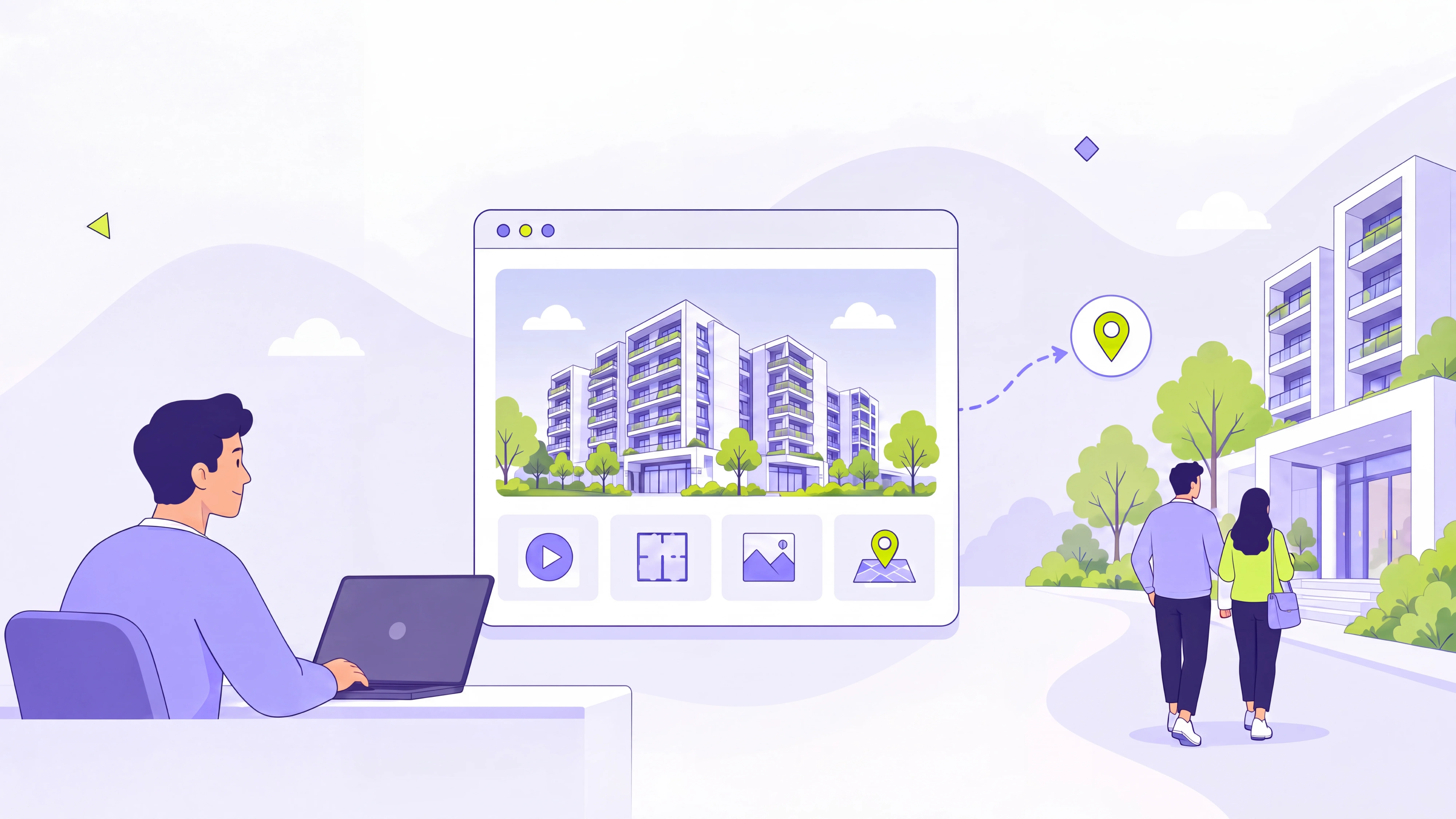
The engagement with Lands & Homes covered exactly this range. The full Lands & Homes case study is here. The company needed brand identity, business design, website, design thinking, app design, and digital strategy delivered as one continuous engagement. Every workstream inherited from the previous one, which is why the finished platform reads as one company at every point of buyer interaction. Visit Lands & Homes to see how the discovery and positioning translated into the finished platform.
Website and digital experience
Website is a distinct workstream from brand identity, and it should be scoped as one. A complete website engagement is not just a design and build. It is a strategic asset that carries the positioning into the market and supports digital transformation, especially for growth-stage companies moving more customer journeys online.
- Information architecture and content strategy
Sitemap, page hierarchy, content depth, user journey mapping
- UI design and design system application
Wireframes, high-fidelity design, component library, responsive design
- Development
Platform choice, build, CMS setup, integrations
- SEO and analytics setup
Foundational SEO, content architecture for search, analytics infrastructure
- Post-launch measurement
Conversion rate baselines, iteration framework, A/B testing infrastructure
A website scoped as a design deliverable ends at handover. A website scoped as a business design workstream continues to be measured and improved after launch.
Sales and marketing systems
The most under-scoped workstream in most engagements. Brand and website get most of the attention, but the systems that actually deploy the brand across sales and marketing are what determine whether the engagement produces returns and support future growth.
- Sales enablement
Master pitch deck, one-pagers, battlecards, proposal templates
- Marketing collateral system
Ad templates by channel, content templates, email design, campaign frameworks
- Content and thought leadership foundation
Blog templates, case study formats, editorial systems the marketing team can run
- Launch collateral
PR kit, launch content, founder positioning materials for the first 90 days
Repeated testing inside sales and marketing systems also builds organizational agility when experimentation is embedded in company culture.
Engagements that skip this workstream deliver a brand and a website, and then leave the client to figure out how to use them across every subsequent quarter.
Launch, go to market, and ongoing partnership
Launch is not a phase inside the engagement. It is often a separate scope, and increasingly a retainer arrangement that continues after the initial launch project; many business design projects also continue beyond launch through measurement and validation.
- Launch strategy and sequencing
Launch sequence covering PR, content, sales enablement, and category conversations
- Founder positioning
LinkedIn strategy, media presence, thought leadership content
- Measurement and iteration framework
Metrics defined before launch, tracked after, with KPIs tied to business goals, and iterated on quarterly
- Ongoing partnership
Retainer engagements for continued brand, content, and marketing work
Our engagement with Chargnex followed exactly this pattern. Business design, brand identity, app design, and consumer research delivered as one continuous scope, launched as a coherent global EV charging platform, and continued into ongoing partnership as the company scaled.
What is not included in a business design engagement
Just as important as what a complete engagement includes is what it does not. Founders sometimes expect business design partners to deliver work that sits outside the discipline, and setting expectations upfront prevents scope disputes later.
- Ongoing performance marketing execution
- Business design partners set the strategy and creative direction. Media buying and daily campaign management sit with performance marketing agencies or in-house teams
- Product engineering
- Business design covers product experience and interface design. Backend engineering and product feature development sit with the product team
- Ongoing sales execution
- Business design builds the sales enablement system. Running the sales process sits with the founder and sales team
- Full-service PR retainers
- Business design supports launch PR strategy. Media relationships and ongoing outreach sit with a PR agency
A complete business design engagement is the strategic and creative foundation for all of these. It is not a replacement for the specialist functions themselves.
How long does a complete business design engagement take
A complete engagement covering all seven workstreams in a broader business design process for a growth-stage company usually runs 16 to 24 weeks. Depending on complexity and parallel workstream execution, the range can extend to 28 or 30 weeks for larger scopes.
- Discovery and positioning strategy- 4 to 6 weeks
- Brand identity and design system- 4 to 6 weeks, usually overlapping with the end of positioning
- Website and digital experience- 6 to 10 weeks, running in parallel with product design where relevant
- Product or service experience- 6 to 12 weeks depending on scope, usually the longest workstream
- Sales and marketing systems- 3 to 5 weeks, running toward the end of the engagement
- Launch and initial optimisation- 2 to 4 weeks pre-launch, then 30 to 90 days post-launch
A traditional business plan can look complete on paper but still needs testing and iteration across these phases.
Compressed timelines under 12 weeks almost always skip discovery, positioning, or launch systems. Extended timelines beyond 30 weeks usually indicate scope creep or unresolved strategic questions in early phases.
Common mistakes founders make when scoping a business design engagement
- Choosing based on total price without comparing scope across proposals
- Assuming the agency's stated scope matches every other agency's stated scope
- Underinvesting in discovery, then paying for it in revision cycles later
- Skipping the sales and marketing systems workstream and figuring it out post-launch
- Treating launch as a separate project after the engagement ends
- Hiring separate vendors for each workstream to save money and paying more in coordination cost
- Expecting business design partners to also run performance marketing, engineering, or sales execution
- Not defining measurement criteria before design begins
Each of these produces the same outcome. An engagement that produces partial outputs, a company that reads as fragmented across touchpoints, and a founder who ends up hiring additional vendors to fix what should have been included in the first place.
The closing signal
A complete business design engagement is not a menu of services. It is a system where each workstream shapes the one after it, and the coherence of the outcome depends on all seven being delivered under one team. Founders who scope this correctly get a company that reads as one company across every touchpoint. Founders who scope partially get fragments they then have to stitch together for the next two years.
At Mellow Designs, we work with growing companies across India on complete business design engagements. Discovery, positioning, brand identity, product experience, website, sales enablement, and launch as one continuous scope, delivered by one team, measured against one set of outcomes. The companies we have worked with, from Lands & Homes building a real estate platform to Chargnex defining a new global category, all invested in the full scope. The result in every case is the same. A company that does not have to explain what it stands for, because every surface already does.



.svg)


