


.svg)
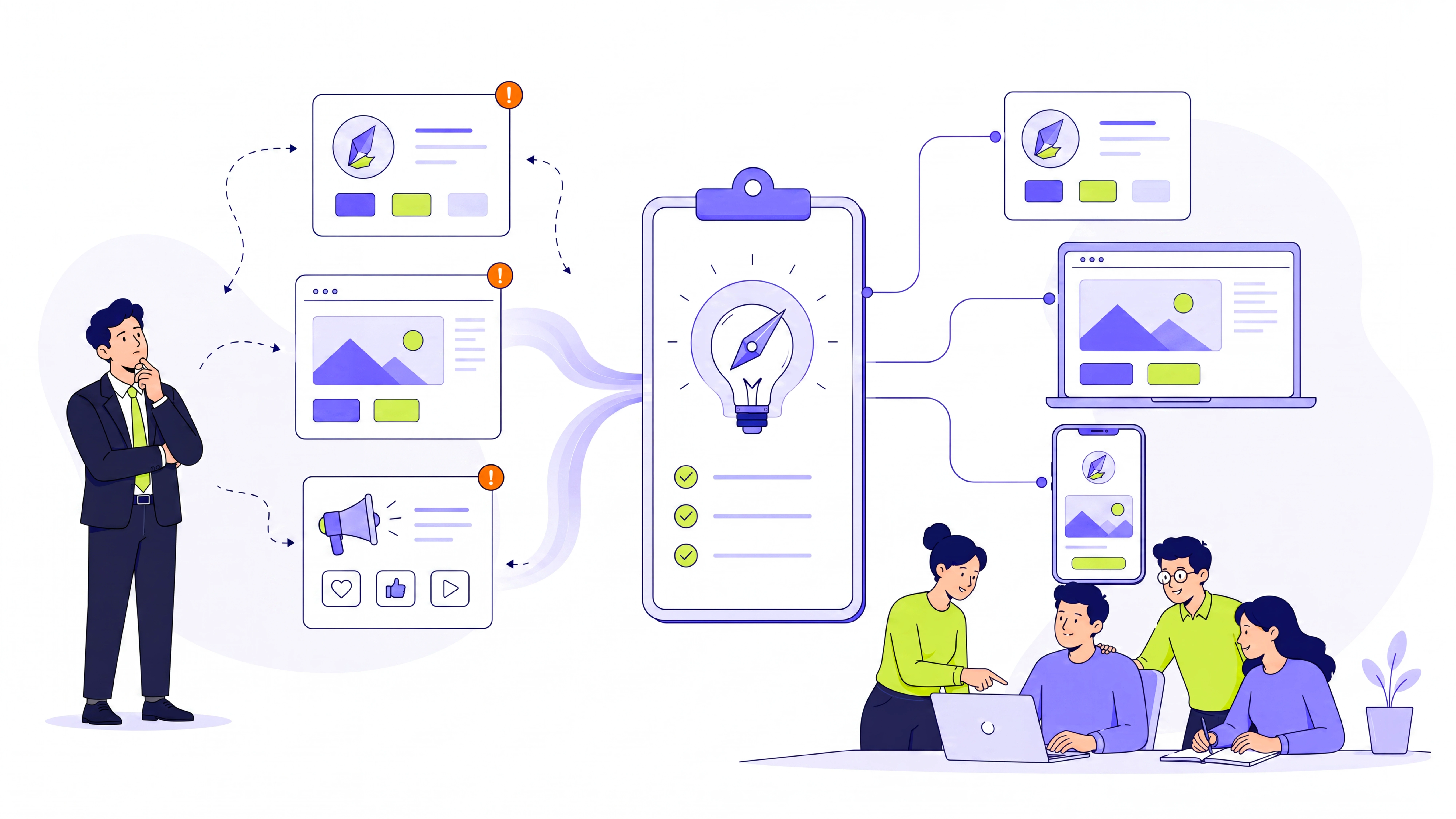
Every growing company reaches a point where the number of vendors in the marketing and design stack becomes a management problem in itself. A branding agency handles the identity. A separate studio builds the website. A UI/UX shop works on the product. A content agency writes the blog. A performance marketing agency runs the ads. A PR firm handles media. Each of them costs a coordination tax that no one line-items on the invoice, and each of them interprets the brand slightly differently from the last.
At some point, usually around the third quarter of managing this stack, the founder asks the question every scaling company eventually asks. Would this all work better if one partner held everything?
The short answer
Growing companies should hire one integrated business design partner when brand, website, product, and marketing all have to feel like the same company, when the leadership does not want to spend 30 percent of their time managing vendor coordination, and when the compounding returns of one team learning the business over years outweigh the specialist depth of separate agencies. Companies should hire multiple specialists when they already have a strong in-house design leader who can hold coherence, when specific workstreams are unusually complex and require narrow expertise, or when the scale of the business justifies a dedicated agency per function. Most growing companies are the first case, not the second, which is why the shift toward integrated business design partners is accelerating.
How growing companies in India choose between integrated business design partners and multiple specialist agencies
Growing companies in India choose between integrated business design partners and multiple specialist agencies by evaluating three factors. The coherence of the outcome, the total cost of coordination, and the compounding value of a long-term relationship. The right business design services combine brand strategy, brand identity, product design, website, and marketing systems into one continuous engagement, which is usually cheaper in total cost and stronger in coherence than hiring separate agencies for each workstream.
The best integrated business design partners in India come from studios that can hold strategy, design, and execution under one team without handing off to external vendors mid-engagement. A well-executed integrated engagement produces a company where the brand, website, product, and marketing all read as one voice, because they were designed by one team working from one strategic brief. Design for business always ends in commercial outcomes, and coherence is one of the strongest predictors of whether those outcomes actually arrive.
What business model design actually is
Business design is a discipline that applies design thinking and human centered design methodologies to business challenges. Emerging in the early 2000s, the field is still evolving in its early stages. It connects business strategy, business model design, and customer experience into one integrated practice. Where traditional business strategy focuses on financial modeling and management consultancies focus on business logic, business designers work at the intersection of business and design.
Business designers work with founders, business leaders, and internal stakeholders to shape new business models, launch new business ideas, and translate design solutions into measurable business impact by aligning customer needs with business goals; a user-centric approach starts with research into the target market and potential customers. The discipline covers business strategy, cost structure, revenue model, value proposition, and value creation, alongside brand and customer experience. Business design has become a core practice for growing companies navigating shifting competitive landscapes because the questions they face, how to build a sustainable business model, how to grow market share against established competitors, where the next competitive advantage will come from, cannot be answered by pure strategy or pure design alone. In practice, the business design process often moves through Empathize, Define, Ideate, Prototype, and Test as a flexible design process rather than a rigid sequence.
Business designers create prototypes, and where relevant work with product designers to create products and products and services, test a product idea or digital product with potential customers, and use evidence from customer research and performance metrics to decide before committing capital. A business design team usually operates with different perspectives across strategy, design, and research to make competition irrelevant rather than merely to compete.
For a growing company weighing an integrated business design partner against multiple specialist agencies, this business perspective matters. The integrated partner does not just deliver design work. They shape the business model, the value proposition, and the customer experience alongside the visual outputs. Specialist agencies typically execute inside one function without holding the strategic frame. This difference is what makes the two models produce structurally different outcomes over time, with design thinking now embedded in organizational capabilities for innovation, digital transformation, and business model innovation.
Why the multi-vendor model produces fragmented brands
The multi-vendor model looks efficient on paper. Specialists in each function should produce the best possible work in each function. In practice, the model has a structural failure that shows up around the fourth month of scaling.
Every downstream vendor inherits from every upstream one. The website agency inherits from the branding agency. The product designer inherits from the website. The content team inherits from everyone. When these vendors do not talk to each other, or when they interpret the previous work slightly differently, the drift compounds. By the time all five vendors have delivered, the company reads as five slightly different companies to the same customer.
- The branding agency delivers a brand book
- The website agency reads it and builds a site that expresses only 70 percent of it accurately
- The product designer takes the website
- Delivers an interface that expresses 70 percent of the website's version of the brand
- The content team reads the product
- Writes in a voice that expresses 70 percent of the product's version
- The marketing agency reads the content
- Runs campaigns that express 70 percent of the content's version
Multiply 0.7 across five vendors and the buyer ends up experiencing something close to 17 percent of the original brand intent. The founder can feel this happening but rarely knows where the drift started. The answer is that the drift is structural. It is a feature of the multi-vendor model, not a failure of any specific vendor inside it.
Why integrated business design partners produce value creation and coherent companies
Integrated partners solve the coherence problem structurally. The same team holds every workstream, which means the positioning decision made in week three shapes the identity direction in week seven, which shapes the website in week eleven, which shapes the product design in week fifteen. Coherence is not a bonus outcome. It is a structural outcome of having one team hold every layer.
- One team, one strategic brief
- Every workstream inherits from the same source, not from an interpretation of the previous vendor's work
- One creative director
- Every design decision is made against the same aesthetic principles
- One relationship with the client
- The founder does not have to explain the business five times to five different vendors
- One measurement framework
- Every workstream is measured against the same commercial outcomes
The engagement with BootLabs shows what integrated delivery produces. The full Bootlabs case study is here. The company was a homegrown tech brand preparing to scale globally, and every layer of the launch had to feel like one company from the first customer touchpoint. Brand identity, website, design system, and positioning delivered as one integrated engagement, which is why the finished company reads as coherent even though the team behind it was building it from zero. Visit BootLabs to see how the integrated engagement translated into the live digital experience.
The real cost of multi-vendor coordination
Founders often assume that hiring specialist agencies is more cost-efficient than hiring one integrated partner. The invoice tells one story. The total cost of ownership tells another.
- Coordination time
- Every additional vendor adds hours of client-side coordination per week
- Five vendors means the founder or a senior team member spends 20 to 30 hours per month just managing the stack
- Duplicated discovery
- Each vendor runs its own version of discovery, briefing, and onboarding
- Total discovery time across five vendors is often 4 to 6 weeks longer than one integrated engagement
- Rework from drift
- When downstream vendors interpret upstream work differently, revision cycles multiply
- Total revision time across the stack is often 30 to 50 percent higher than in integrated engagements
- Coherence loss that shows up as marketing inefficiency
- Fragmented brands convert worse across every channel
- Cost per acquisition rises, retention falls, referral drops
- Onboarding cost when vendors change
- Turnover in any one vendor forces re-onboarding the rest
- Every replacement costs 30 to 60 days of context rebuild
When these are added up honestly, the multi-vendor model is usually 30 to 40 percent more expensive over 18 months than one integrated business design engagement, and the coherence penalty compounds beyond that.
When multiple specialists actually make sense
The integrated model is not always the right answer. For some companies, multiple specialist agencies are the correct choice, and it is worth being honest about when.
- When a strong in-house design leader can hold coherence
- Companies with a senior in-house design director or Chief Brand Officer can coordinate specialists effectively
- The in-house leader replaces the coordination function of an integrated agency
- When specific workstreams are unusually complex
- Enterprise SaaS with 40 product surfaces may need a dedicated product design agency
- Global consumer brands with 15 regional markets may need regional creative agencies
- When the scale of the business justifies a full agency per function
- Companies spending over 5 crore per year on marketing and design usually have the volume to keep multiple specialist agencies fully engaged
- When existing relationships are irreplaceable
- Some agency relationships have compounded over years, and switching costs would outweigh the coherence gain
Most growing companies in the 3 crore to 100 crore revenue range do not fit any of these cases. They usually do not have a senior in-house design leader. They rarely have workstreams complex enough to justify dedicated agencies. They spend less than the volume needed to keep specialists fully engaged. And they are early enough in their growth that vendor relationships have not yet compounded. This is why the integrated model produces better returns for the majority of the market.
The compounding return of long-term integrated partnerships
The strongest argument for the integrated model is not the coherence at launch. It is the compounding return of the same team learning the business over years.
- Year one
- The partner learns the business, the market, the positioning, the customer
- The initial engagement launches with coherence but the compounding has not yet started
- Year two
- The partner starts anticipating the business
- New workstreams get delivered faster because context is already loaded
- Iteration on existing work gets sharper because the partner has seen what worked and what did not
- Year three and beyond
- The partner becomes an extension of the business
- Strategic decisions get made together, not delivered as briefs
- The cost of new engagements drops because the context is already there
- The quality of the work compounds because the partner has stakes in the outcome
Our engagement with Helios shows this compounding effect over five years. The full Helios case study is here. The company scaled from 40 to 250 stores while Mellow held brand identity, website, motion design, SEO, GEO, and brand strategy under one continuous partnership. Ecommerce sales grew 2.2x and organic traffic scaled by up to 3x over the partnership. See how the compounding partnership shows up in the finished digital experience at Helios.
How to evaluate an integrated business design partner for business strategy
If the integrated model is the right fit, the next question is how to evaluate which integrated partner to hire. The failure mode here is hiring a design agency that claims to be integrated but is really strong in one workstream and weak in the others.
Ask for named case studies where they delivered every workstream
- Not case studies where they did brand and then a different agency did the website
- Look for projects where brand, website, product, and marketing all came from the same team
Meet the actual delivery team, not just the pitch team
- Integrated agencies often have a strong pitch team and a weaker delivery bench
- The people on the pitch should be on the project, along with the senior design teams who will actually run the engagement
Test their strategic depth in a chemistry call
- A real integrated partner will interrogate the brief, not just accept it
- If they cannot push back on a founder's assumptions, they will produce work that inherits from those assumptions, and they should also be able to connect design choices to a business plan and core business principles, not just creative taste
Ask about long-term client relationships
- Integrated partners who cannot sustain multi-year relationships are probably not really integrated
- Ask for two clients they have worked with for more than two years
Compare their scope of internal capability
- Do they have positioning strategists, brand designers, product designers, developers, and content people on the team
- Or do they subcontract half of it to other professionals, in which case they are really a project manager wrapping other vendors rather than a partner that can support business design projects across different industries because it combines design background with business knowledge
How much does an integrated business design partnership cost
An integrated business design partnership in India typically ranges from 25 lakhs to 1 crore per year for growth-stage companies, depending on the scope of workstreams included and the intensity of the engagement.
For comparison, hiring separate specialist agencies for brand (10-25 lakhs annually), website (8-20 lakhs annually), product design (15-40 lakhs annually), content (6-15 lakhs annually), and marketing (12-30 lakhs annually) typically totals 51 lakhs to 1.3 crore per year, before coordination costs.
The math usually favours integration by a meaningful margin, especially when the coordination cost of managing five vendors is factored in honestly.
Common design thinking mistakes companies make with the vendor stack
- Hiring specialists in every function without a senior person to coordinate them
- Assuming multi-vendor stacks produce better work because each function has a specialist
- Choosing agencies based on invoice cost rather than total cost of ownership
- Underestimating the coordination time cost across five or six vendors
- Waiting until the brand feels visibly fragmented before consolidating
- Hiring an integrated partner but continuing to run parallel specialist relationships that create confusion
- Consolidating too early with a partner who does not actually have integrated capability
Each of these produces the same outcome. A vendor stack that costs more, delivers less coherence, and consumes more leadership time than it should.
The closing signal
The decision between one integrated design partner and multiple specialist agencies is not a taste decision. It is a structural one. Companies that need coherence across brand, website, product, and marketing are usually better served by one team holding every workstream. Companies with strong in-house design leadership, complex specialist needs, or the scale to justify full agencies per function are usually better served by multiple specialists.
At Mellow Designs, we work with growing companies across India as an integrated business design partner, combining a design mindset with business strategy to help create uncontested market space and support future growth. Brand strategy, brand identity, website, product design, and marketing systems delivered as one continuous scope by one team. The companies we have worked with, from Bootlabs building for global scale to Helios compounding over five years of partnership, all chose the integrated model because the cost of fragmentation was higher than the cost of consolidation. That is the calculation every growing company eventually makes, and the answer is usually the same.



.svg)


